
USB use cases
Application Description
An example demonstrating how to use the USB API in the Aurora operating system. It shows one way to build and use the libusb library.
Contents
- Compatibility
- Build Features
- Branch Information
- Installation and Launch
- Screenshots
- Project Structure
- Usage Rules and Participation in Development
Compatibility
The project is compatible with Aurora OS version 5.2 and higher.
Build Features
The project is built in the usual way using the Aurora SDK. Restriction: The project does not build until version 5.2.0 due to the lack of Libdevicewarden
Branch information
The application versions comply with the branch name convention
Installation and launch
The application is installed and launched according to the Example build instructions.
The application must have UsbDevices permissions to work. These permissions are set in the .desktop file.
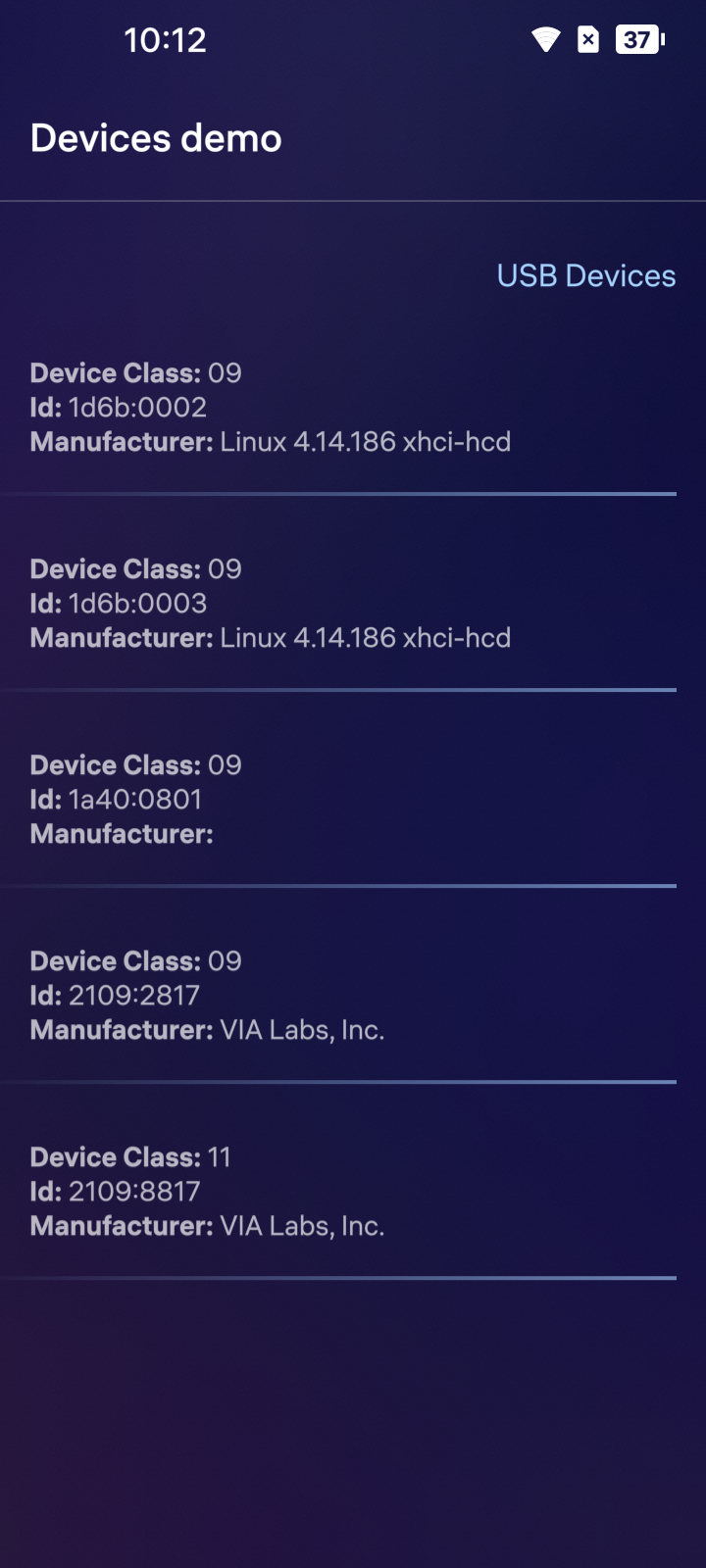
Screenshots
Project Structure
The project has a common structure of an application based on C++ and QML for Aurora OS.
- CMakeLists.txt file describes the project structure for the cmake build system.
- icons directory contains application icons for different screen resolutions.
-
qml directory contains the QML source code and the UI resources.
- cover directory contains the application cover implementations.
- icons directory contains the custom UI icons.
- pages directory contains the application pages.
- ru.auroraos.usb.qml file provides the application window implementation.
- rpm directory contains the rpm-package build settings. ru.auroraos.UsbUseCases.spec file is used by rpmbuild tool.
-
src directory contains the C++ source code.
- main.cpp file is the application entry point.
- translations directory contains the UI translation files.
- ru.auroraos.UsbUseCases.desktop file defines the display and parameters for launching the application.
- libusb directory contains the source code of the libusb library.
Terms of Use and Contribution to Development
The source code of the project is provided under a license, which allows its use in third-party applications.
The Contributor Agreement regulates the rights granted by the participants of the Open Mobile Platform company.
Information about the participants is specified in the AUTHORS file.
Code of Conduct is the current set of rules of the Open Mobile Platform company, which informs about the expectations for interaction between community members when communicating and working on projects.